


Title credit: @skgoodwin23
“Unquestioningly, some of our core strengths became liabilities last fall, including perhaps a degree of over-confidence in our ability to weather almost any market catastrophe” – Ken Griffin, 2009, in a letter to LPs
Citadel lost $8B in 2008 – a 55% drawdown that nearly destroyed the firm Ken Griffin had spent 20 years building.
As is often the case in life and in business, this came right after a high point. Citadel was coming off a +30% year, assets had peaked at a record $20B and Ken Griffin – just 41 – sat at the top of the food chain.
He had already built a reputation as an opportunistic apex predator: recruiting from Enron’s abandoned trading floor and absorbing Amaranth’s portfolio.
At the onset of the subprime crisis, he pounced on the opportunity to rescue ResMae Mortgage, Sowood Capital and E*Trade.
The problem? He was too early.
Citadel was deploying aggressively into a downturn that proved deeper and longer than expected. At 7:1 leverage, there was almost no room for error.
Despite the blood in the water, Citadel avoided becoming a forced seller. It contained the rumours, secured enough liquidity and held its positions.
Nonetheless, the experience rewired the firm’s approach to risk.
Citadel has not had a down year since.
Staying Power
Nothing like summer doldrums to ignite some volatility in the markets.
Whether it was:
The liquidation of Leopold’s public book and over 1.2m Korean retail accounts
US 30Y touching 5.2% and credit spreads widening in AI infrastructure
MSFT / AMZN outperforming (+21.7% and +17.0% on the week respectively)
All were expressions of the same idea: path dependency.
Few doubt that AI will profoundly reshape the economy.
That does not mean every investor or company expressing that view will make money. In fact, it is often the biggest believers who end up blowing up along the way.
Recent events are a stark reminder that leverage (and its structure), duration and concentration all matter.
Experienced market participants will always value flexibility over marginal pricing gains.
For debtors (whether funds, investors or companies), that means prioritising runway and control in adverse scenarios over an extra 25bps.
Creditors must decide whether that flexibility is worth extending and at what price.
Being right is useless if you cannot reach the finish line.
We argued last week that ORCL was stretching its toolkit in a way which increasingly required perfect execution.
In contrast, we had the following to say about MSFT:
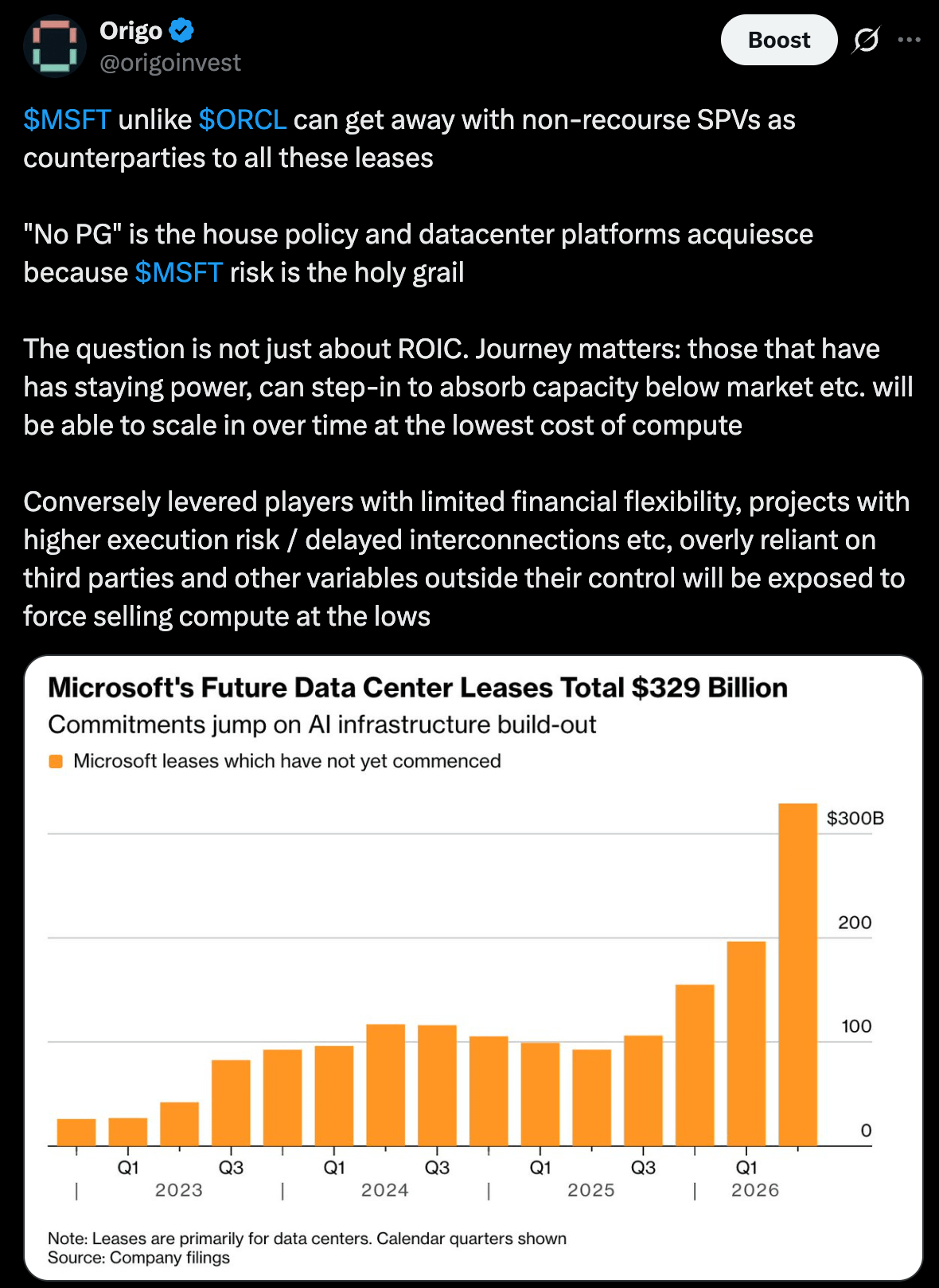
MSFT is positioned to act as a Citadel in times of stress.
Credit markets don’t like binary outcomes
Gavin Baker – who is infinitely more knowledgeable about the AI ecosystem than we are – came out with the following tweet:

What he is saying probably makes sense through the lens of an equity investor and no doubt a decent % of the AI capex spend is +EV.
Credit has the opposite payout asymmetry and in our view the recent repricing is absolutely warranted.
This wouldn’t be the first industry where spot prices ran ahead of contracted economics as a precursor to oversupply.
CoreWeave felt that push back this week. The Company sought a delayed-draw term loan to fund new leases and GPU purchases against a concentrated compute-contract book, with Anthropic representing 40%.
Initial terms were reportedly a non-starter. Investors demanded tighter covenants, a lockbox feature with a revenue-based based waterfall and wider pricing (+550bps over SOFR at a 96-97c OID). They also flagged the mismatch between 15 year leases and rolling 3-5 year compute contracts.
AI infrastructure is increasingly a credit story. Expect more scrutiny across the capital structure and value chain. Liquidity has a price again.
Price vs. Expectations
SK Hynix reported record Q2 operating profit, up 557% YoY. Shares still fell another 10%. Another reminder that positioning and expectations matter more than the result.
The mirror image of this is a trade underwritten on unheroic assumptions:
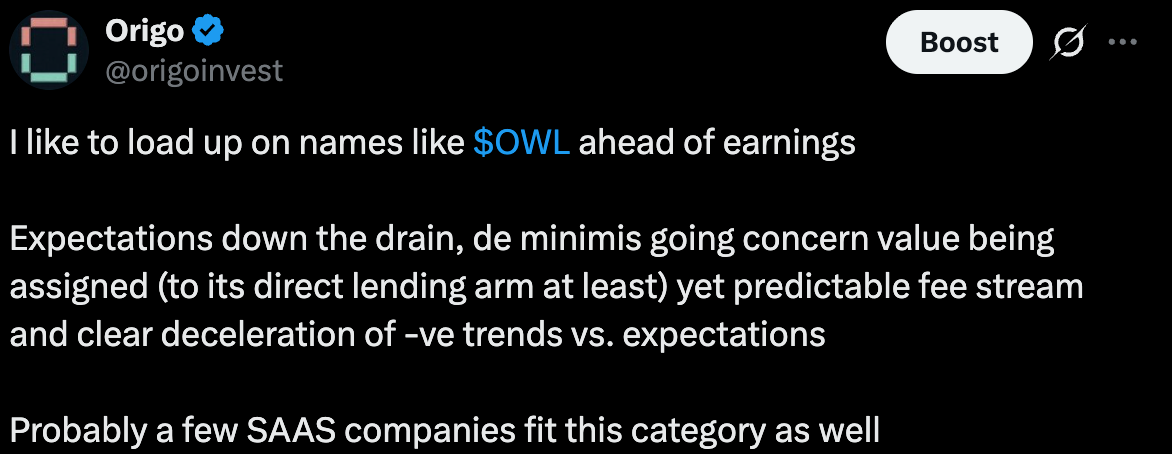
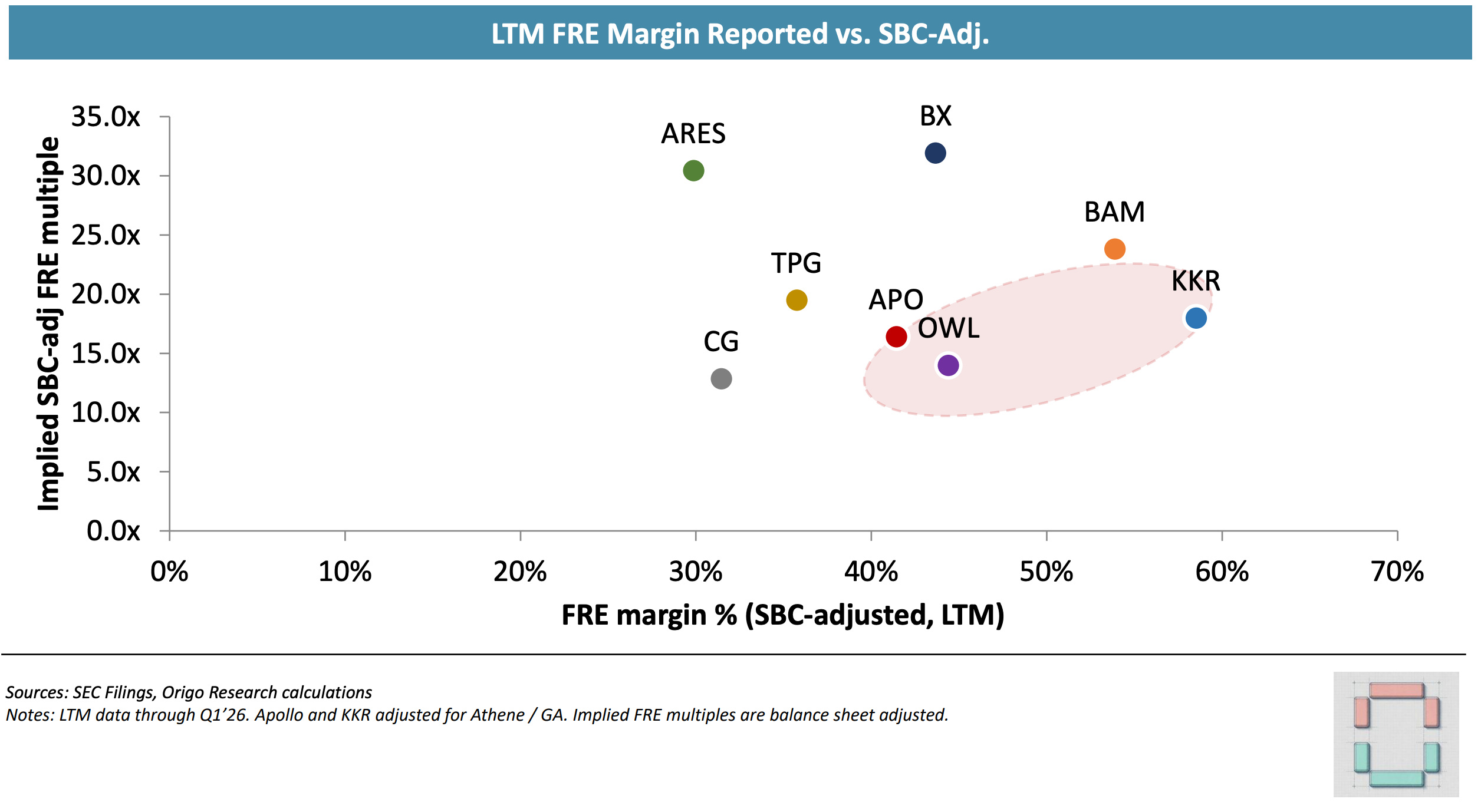
We laid out our longer thesis for OWL on Wednesday before earnings:

As expected, while challenges remain, the sky is not falling:
FRE beat
Institutional flows +30% YoY
Wealth likely troughed in May
Evergreen inflows +50% (low base)
90% of OCIC investors requested zero redemptions
Loan repayments alone cover >3x net outflows
$31B of AUM to be activated (+$380M fees)
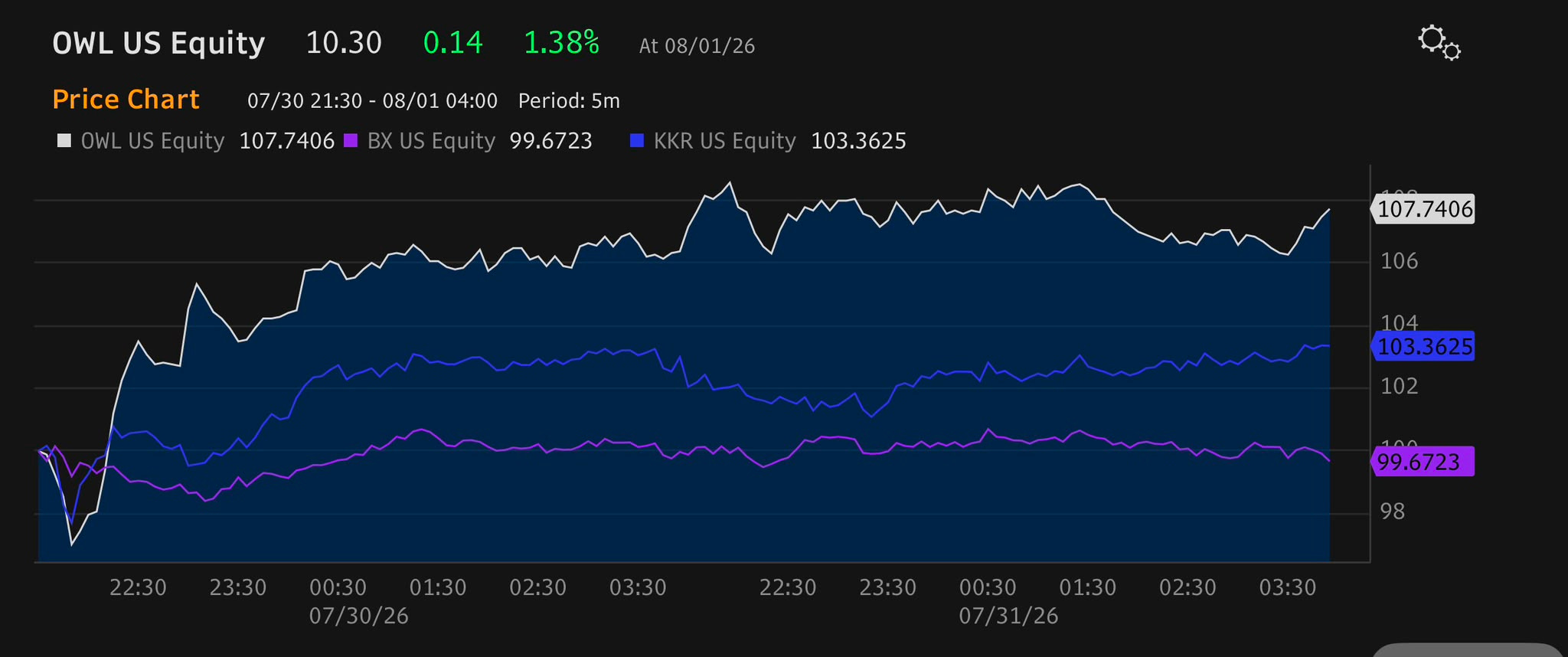
OWL ended up +9% on the week and is now +18% on the month.
Interestingly, KKR reported on the same day.
Contrast the following two headlines:

With the subsequent relative performance:
On the subject of Alt GPs, Blackstone pared some gains after reporting Q2 earnings the prior week with Stephen Schwarzman calling BX stock: “the most inexpensive way of playing the AI mega trend”.
We took a closer look at that assertion. If you have not read it yet, check it out!

Hopefully you are easing into the slow part of summer from somewhere sunny.
At Origo, there is no slowing down: we have a full pipeline of research on the way for you to enjoy over the break!
Thank you for your continued support and please consider sharing Origo with your broader network.