


“Our stock is on sale today, and we believe it represents one of the most inexpensive ways to participate in this extraordinary mega trend”
– Stephen Schwarzman, Q2’26 earnings call
It wouldn’t be the first time Stephen Schwarzman has lamented BX’s valuation. When the large listed asset managers first entered the public sphere in 2015-17, he embarked on a sustained, almost obsessive campaign to convince investors they were underpricing the stock.
Back then, the sector traded at ~9x P/E. The market struggled to assign a higher multiple to volatile, low visibility carry. We know what happened next: FRE became the mantra, the revenue mix grew stickier and more diversified, and Alt GP multiples rerated all the way above 35-40x at the peak – overshooting in the other direction.
Since then, the sector has cooled off. BX specifically sits ~35% below its peak – a middling result relative to peers, reflecting an underperforming Real Estate franchise (former engine) and, potentially, the absence of a captive insurer generating less-correlated inflows.
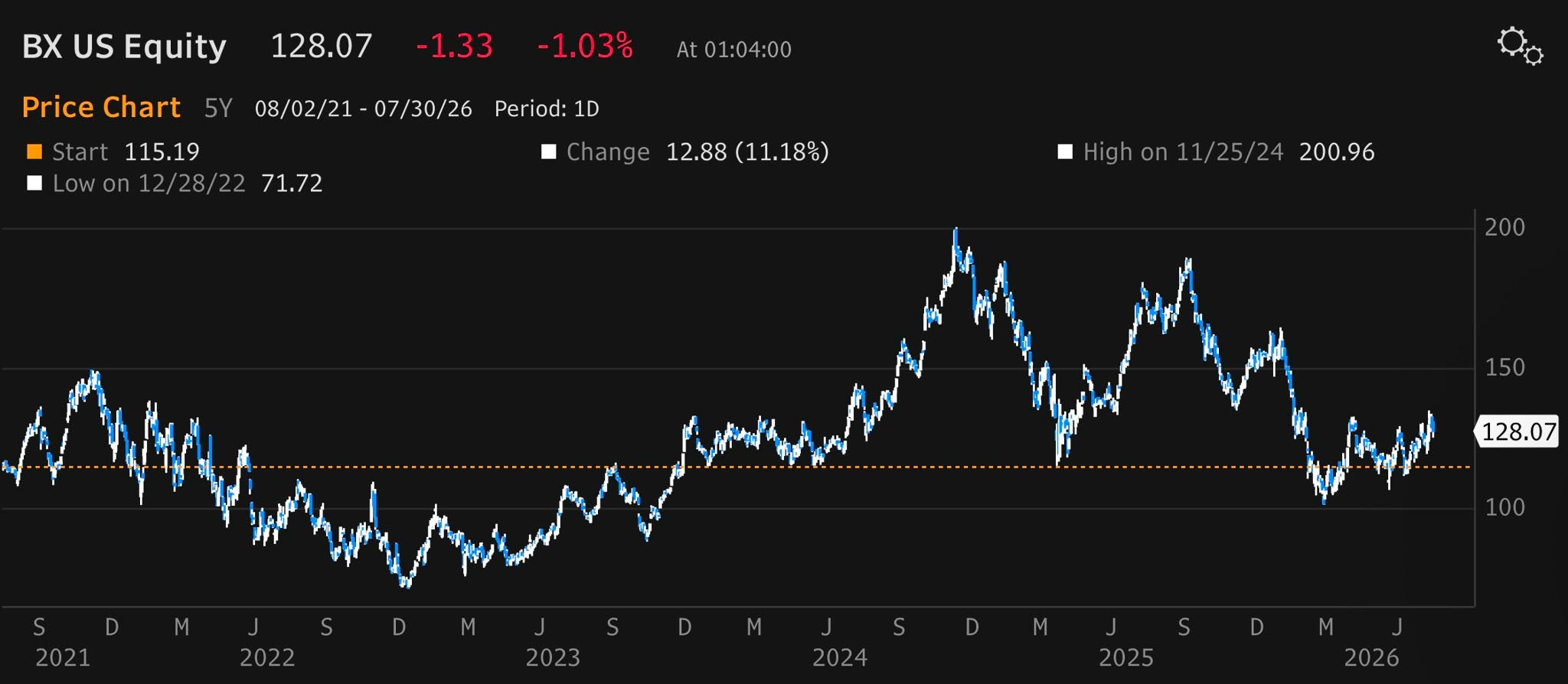
Unsurprisingly, Stephen Schwarzman is attempting to reposition the narrative.
At face value, he has a point: few private-capital platforms have committed as much capital – or spread it across as many parts of the AI stack, particularly on the equity side.
The firm has been putting serious dollars to work across the board. This includes datacenters, power, compute credit and equity in the frontier labs.
Blackstone has also created a dedicated AI unit, N1, to centralise sourcing and expertise (N1 is not a dedicated fund, it draws capital from BXG, Tactical Opportunities and BXPE). How this works in practice remains to be seen.
The key question though:
How does this all translate into value for the GP?
BX shareholders participate through management fees, performance fees, carry and the firm’s comparatively small GP investments – not through direct ownership of the underlying assets.
To its advantage, BX has a higher proportion of equity-related strategies relative to its credit-oriented peers, implying higher potential performance-related fees.
BX currently sits on $7.5B of NAPR (net accrued incentives). It also has material AI exposure inside perpetual vehicles, creating recurring management fees (on an increasing NAV) with periodically crystallised FRPR.
How much of this is captured in the stock at $159B market cap? How should we think about BX relative to peers in the context of its AI optionality? Is this truly a no-brainer way of catching the AI wave while limiting downside?
Keep reading.