

EchoStar has become an orphaned security (again)
No longer relevant as a SpaceX proxy in a post-IPO world. Legacy, melting ice cube businesses. Chapter 11 headlines. Incessant noise linked to contingent claims and unclear timelines. Valuable spectrum assets – yes – but proceeds that have yet to hit the bank. And if and when they do, minority holders remain at the mercy of Charlie Ergen’s next big swing.
A case of post-catalyst depression, as the cold, hard reality sets in. To top it off, negative reflexivity in SPCX is now in full swing: a broken IPO and looming insider unlocks are keeping active buyers on the sidelines till the dust settles. An event already priced in was perhaps not a real catalyst.
Investing is a game of expectations – specifically, understanding what the market is already positioned for.
Increasingly, the prevailing view on EchoStar goes something like this:
Realisable stub value still carries too much execution risk. Better to wait.
No visible direction, with perpetual Ergen torpedo risk.
The SpaceX IPO was the endgame and there is no catalyst left.
Now that we are on the other side of the IPO, we need to be aware that we are at a new decision node, with a new set of parameters, requiring a fresh underwrite.
Recent price action and declining expectations have helped flip the script, giving us another potential bite at the apple:
Old thesis → be early to SpaceX, sell shiny new toy ahead of the event
New thesis (emerging) → Echo stub is actually real, Ergen can be rational
While we did ok with the old thesis, we only partially executed on the way out (TP anchor bias over stated process) and underestimated the sheer liquidity drain from the myriad of secondary SPVs and broader pre-IPO availability.
The new thesis slowly emerging is one that takes us closer to our distressed debt roots: make money when things aren’t as bad as people think. With the wrinkle that in equities, unlike credit, there is no contractual promise at the end of the tunnel.
Show me the incentives: a working theory on Ergen’s endgame.
It is often forgotten that EchoStar is still in the middle of a multi-stage transformation which so far has delivered tremendous value over the past 24 months. In this article, we will articulate the remaining value unlocks and why there is money to be made by simply climbing the wall of worry.
More interestingly perhaps: we will submit a working thesis on Ergen’s endgame, informed by a detailed look into the mechanics of his family estate and the recent shutdown of EchoStar Capital. A speculative endeavour, but with a high payoff that only needs to be right 20% of the time for a compelling set-up.
If our hunch is correct, we would expect a genuinely unpriced catalyst to force a one-off rerating sometime in H1’27.
Climbing the Wall of Worry
EchoStar is trading at a 17% discount to its contractual holdings in SPCX alone.
Suffice to say, the market is assigning very little value to the ECHO stub.
That scepticism has only been exacerbated by continued delays to the AT&T transaction, which ultimately pushed DISH DBS into Chapter 11.
These are the kinds of headlines that prompt even sophisticated investors to put ECHO in the “too hard” bucket—at least until there is more clarity.
1. AT&T: The First Trigger for a Meaningful Clean-Up
The $22.6B transaction has been holding up a series of pre-programmed events.
We believe the only pending CP in the AT&T SPA was satisfied this week, largely under the radar.
The final CP required an amendment to the original T-Mobile–Sprint consent decree, which obliged EchoStar/DISH to operate a nationwide RAN. That obligation needed to fall away explicitly before completion.
From here, DNC must give 10 days’ notice to redeem its 11.75% bonds, which are due to be settled at closing.
We expect that notice any day. It would effectively telegraph an imminent close and set the following in motion:
Repayment of substantially all DNC liabilities
Settlement of Dish DBS $7.6B interco liability (a key CP under the pre-pack)
Subsequent emergence of a deleveraged DISH DBS from Chapter 11
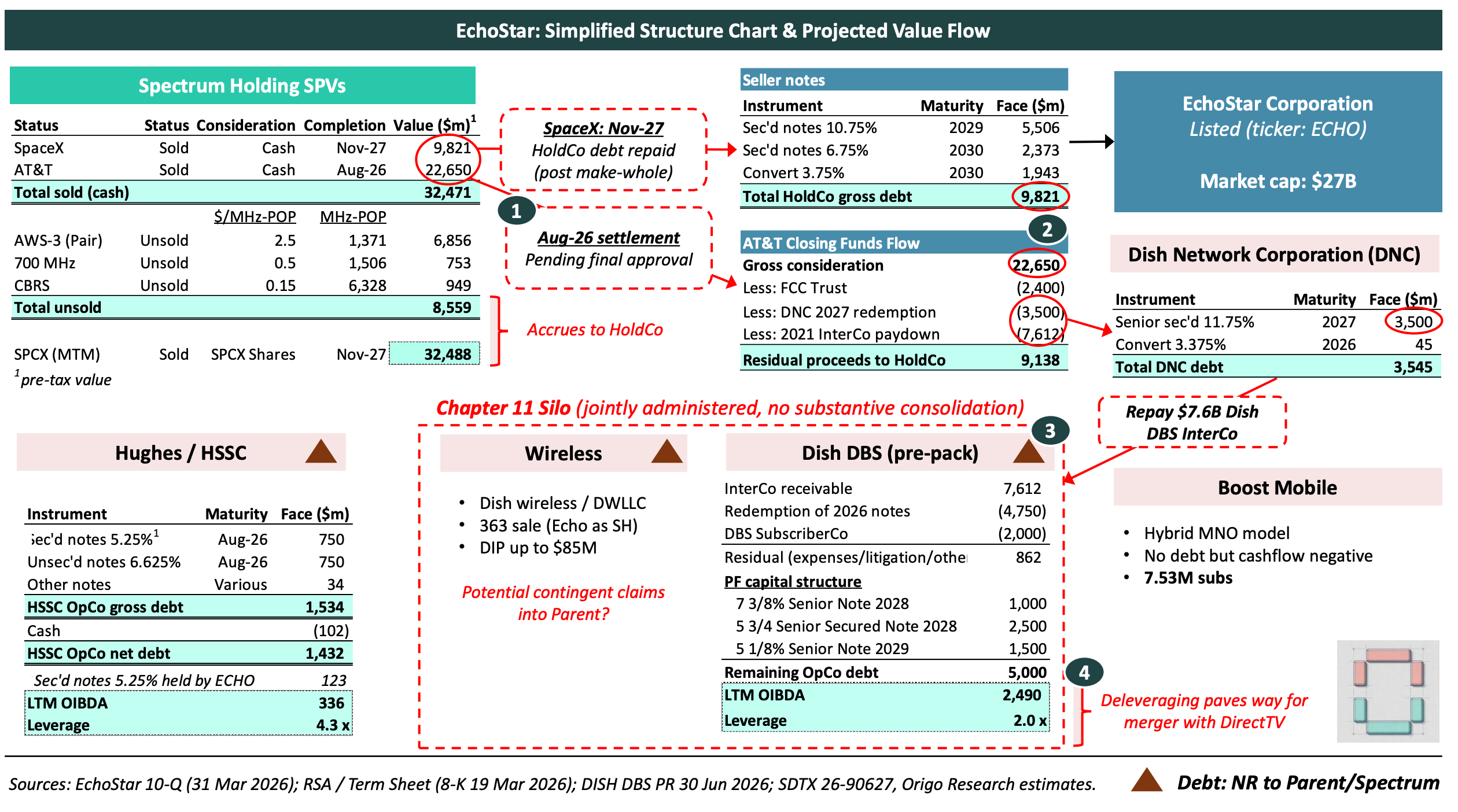
As a reminder, the Dish DBS RSA was originally announced in March (we covered the terms here) and currently has 88% creditor support. Pro forma for the restructuring, the business will emerge at ~2.0x leverage, clearing the path for a potential sale to DirecTV.
2. Extinguishing Contingent Liability Overhang
Some uncertainty remains around residual claims from the Wireless box.
The range of incremental outcomes is relatively modest in the context of the broader thesis. Even so, the overhang is real and needs to be put to bed.
Much of the risk associated with the ~$6B of tower claims is already addressed by the FCC-mandated $2.4B trust – funded from the AT&T proceeds – with some nuance: once the trust is established, claimants must decide whether they prefer to (i) opt in and forfeit any further claims or (ii) continue to fight. We expect that process to take place in August.
Crown Castle is the largest claimant ($3.5B), followed by American Tower ($2.0B). CC is being advised by Paul Weiss, who as one would expect, is pulling out all the stops to justify preserving claims against non-debtor entities and improve its client’s negotiating leverage ahead of an eventual trust opt-in (perhaps with a modest top-up in a downside case).
Other residual Wireless claims should largely be addressed through the 363 sale, with assets transferring free and clear and claims attaching to the sale proceeds or remaining estate.
3. Monetising Legacy Assets
PayTV
We already touched on DISH DBS where the path seems pretty clear. In fact, the RSA makes multiple references to a merger with DirecTV:

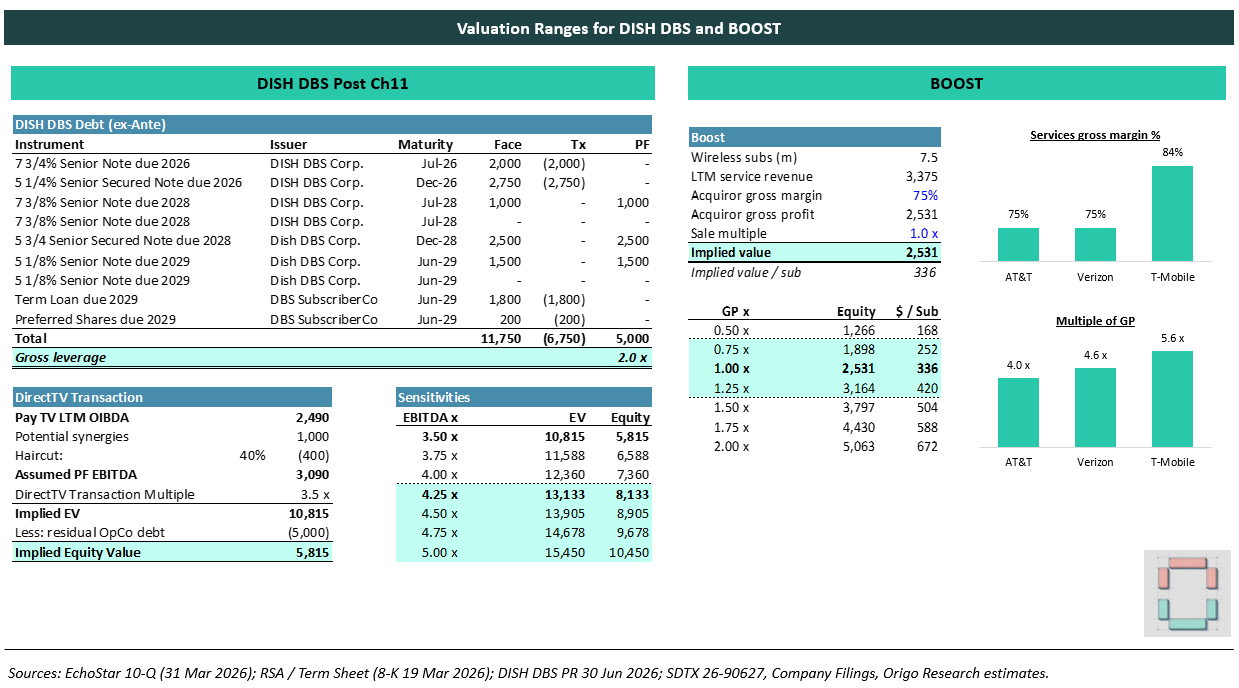
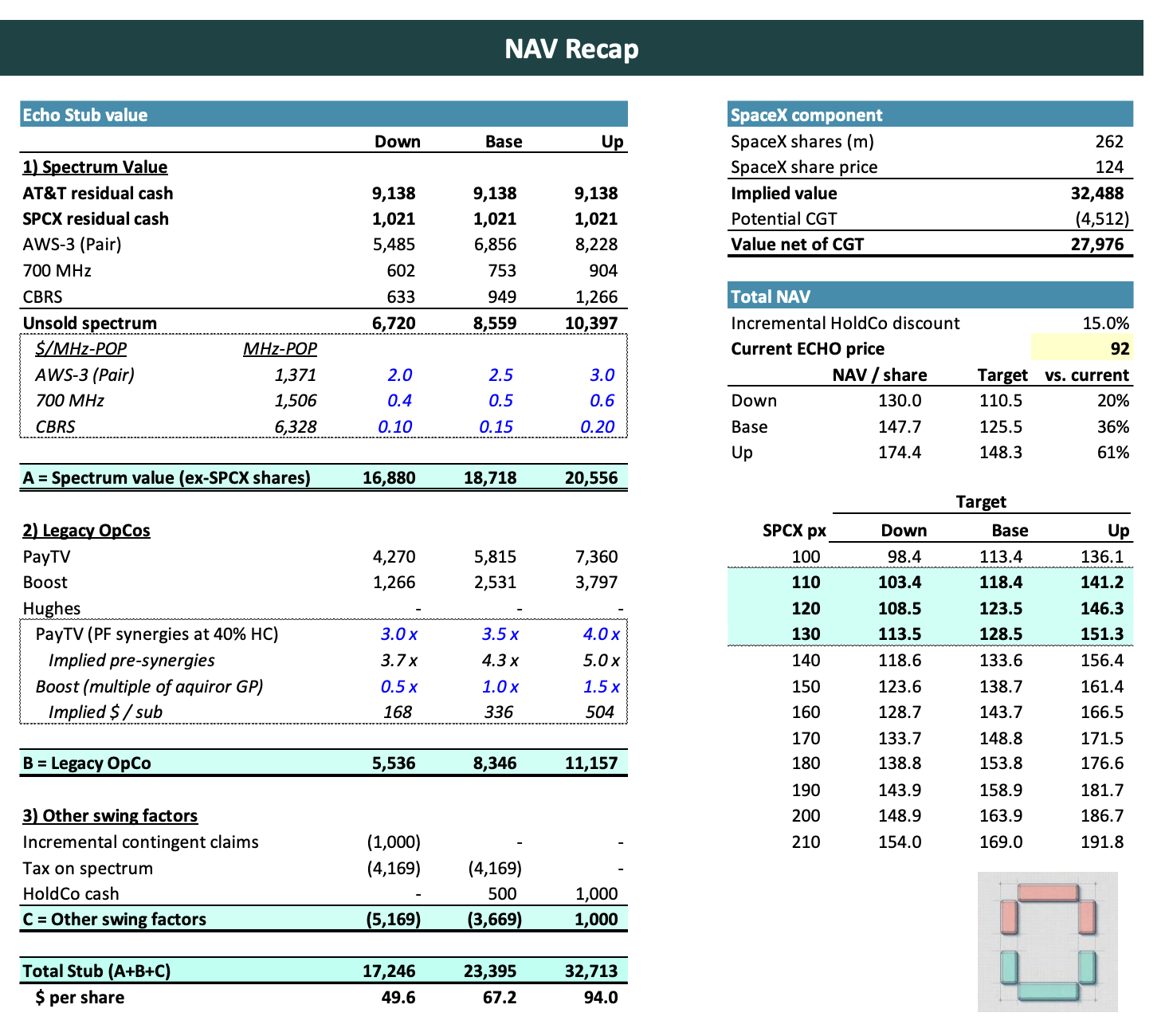
The transaction would have already taken place two years ago if it were not for the capital structure and egregious exchange terms offered to bondholders. Significant synergies of >$1B were being discussed at the time, which would still be relevant albeit at a reduced scale. Haircutting these by 40% and applying a modest 3.5x PF EBITDA, we get at least $6B of equity value back to ECHO (more likely, they are looking to recoup in excess of the DNC intercompany).
Retail Wireless
We view standalone monetisation this year as unlikely. Nonetheless, the existing 7.5M subscriber base has clear floor value.
Boost now runs primarily over AT&T’s RAN, with potential ambitions to reposition as a hybrid terrestrial-satellite operator (through an eventual Starlink D2C agreement).
Despite being a breakeven operation at best today, the 7.5M subscriber base would be of strategic & commercial interest both to existing incumbents as well as SpaceX.
AT&T is a natural here, but T-Mobile and Verizon should also be in a position to absorb the subscriber base at >75% gross service margin. A deal anywhere around 1.0x pro-forma GP would be significantly accretive to buyers vs. their current trading levels, while yielding ~$300 / sub back to Boost / ECHO.
4. Monetising Remaining Spectrum
The recent FCC 113 re-auction provided an interesting read-across which we first touched on here.
In addition to eliminating any contingent liability for ECHO by crossing the $2.9B threshold, the auction ended up clearing at $3.57B or $2.53/MHz-POP.
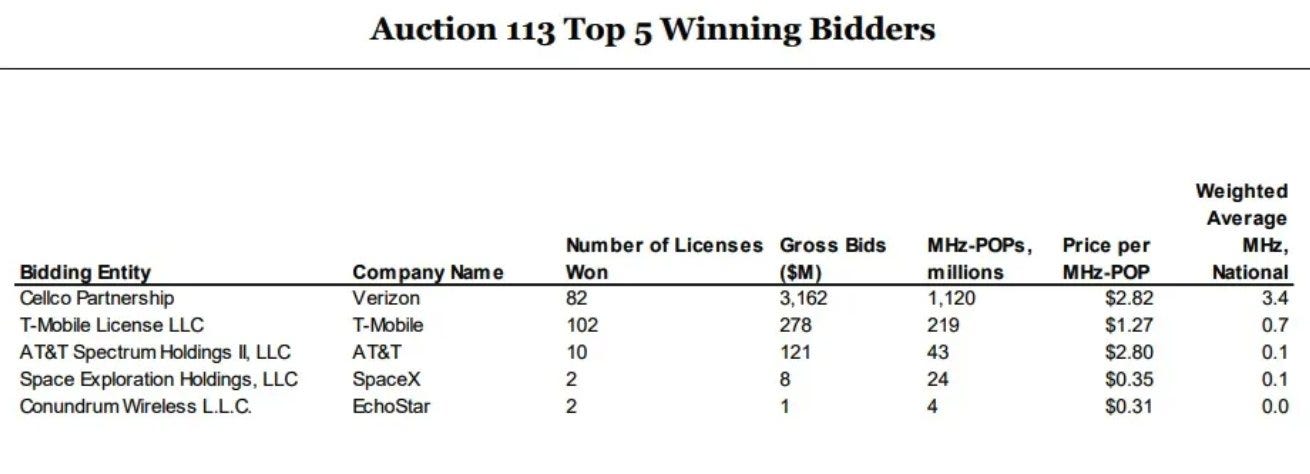
While the remaining AWS-3 spectrum is G-heavy, it forms part of a larger contiguous portfolio (rather than disconnected items) and there are very few near-term opportunities to buy licensed mid-band at scale. Verizon is the most likely buyer here and our $2.5/MHz-POP base case assumption is realistic if not conservative.
A Clean Stub in Six Months?
Within six months, we should be in the following position:
More than $9B of excess cash at HoldCo
Substantially all DNC liabilities repaid
DISH DBS emerged from Chapter 11
DISH Wireless 363 sale completed
Remaining contingent claims resolved
On top of this, it is possible that:
We have a deal on the DirecTV merger
We have a deal on the unsold spectrum
We have a deal on Boost
DirecTV is the most likely of the three, partially since we view the remaining spectrum + Boost as potentially strategic in a broader transaction.
Our “worst” case NAV of $17B assumes the following:
Incremental contingent claims of $1B (on top of the FCC escrow)
Zero HoldCo share out of the $1.5B of reported consolidated cash
Full spectrum tax
Low values for unsold spectrum and legacy OpCos across the board
At the SPCX share price of $124, post-CGT and applying an incremental 15% HoldCo discount on top, we get to $110/share which sits 20% above the current trading price of $92. That uplift extends to 36% and 61% in our base / upside cases respectively, keeping SPCX fixed at $124:
Six months also marks the end of the SPCX insider lock-up, removing overhang on that side of the equation. Even if SPCX falls another 20%, ECHO at $92 still appears to offer meaningful downside protection without a hedge.
Accumulation Window
Realistically, we remain in a bottoming out phase with respect to both SPCX and ECHO. This creates a 2-3 month window to opportunistically accumulate ahead of an inflection point where the market will increasingly start pricing in (i) the reality of the EchoStar clean-up + stub value and (ii) a post lock-up world for SPCX.
Simply executing should be sufficient to generate an attractive minimum return from these levels, recognising that the real overhang remains the strategic direction of the Company — and the uncertainty around what Ergen will do.
We believe Ergen remains underestimated despite having created tremendous value over the past year.
In the following section, we take a look at his incentive structure and a potential endgame resolution that could result in a significant re-rate.