

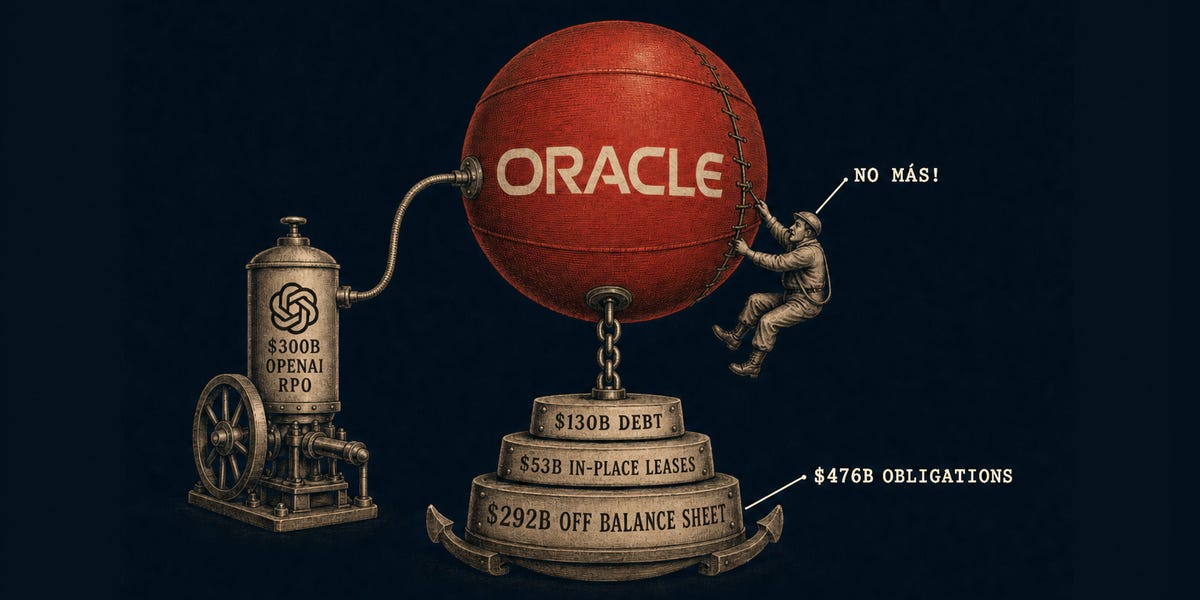
The investment grade credit market is all but tapped-out when it comes to financing Larry Ellison’s gigantic call-option on compute.
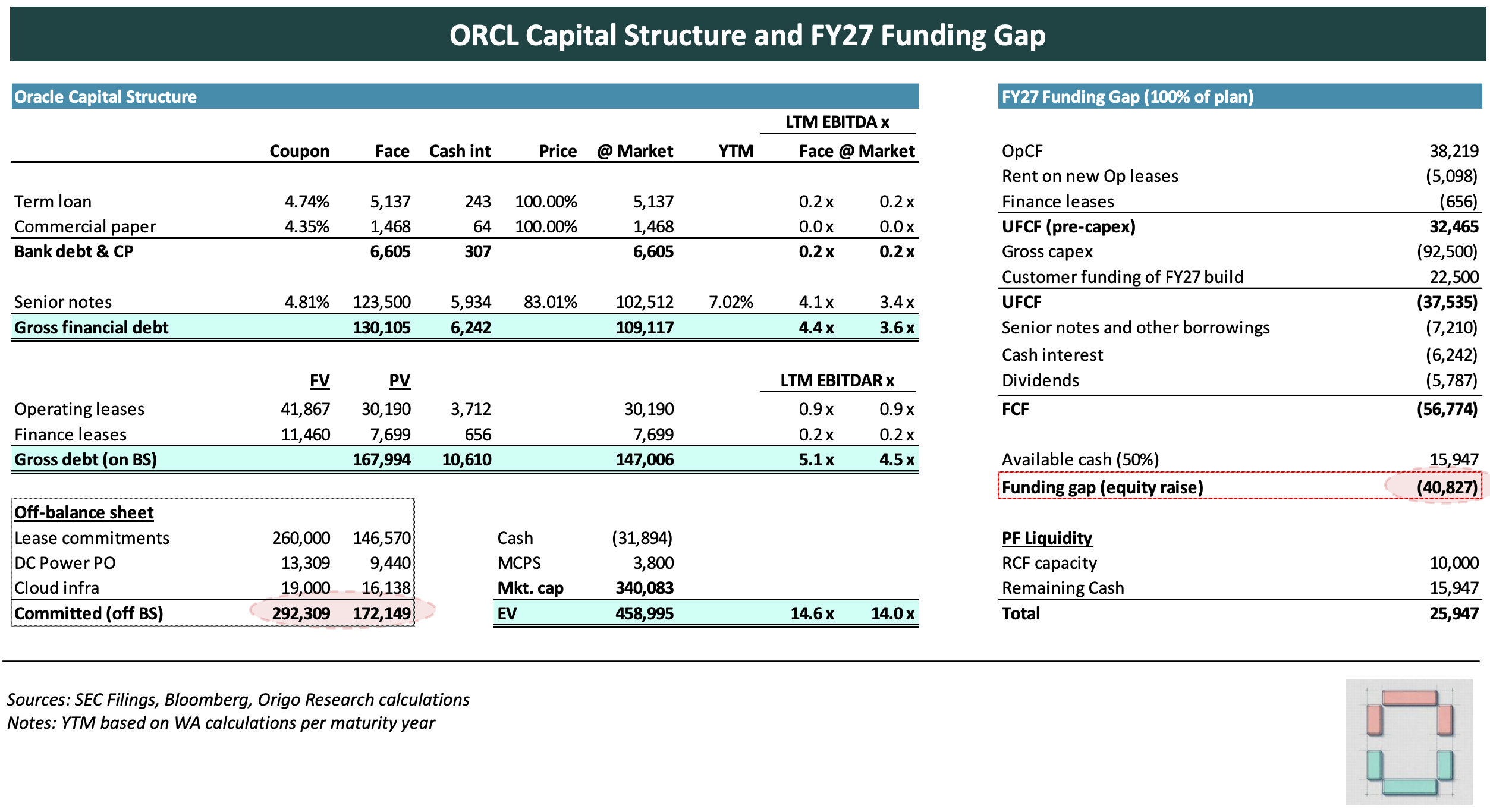
Gross leverage through its $130B financial debt stack already sits at a punchy 4.4x LTM EBITDA, but it is the scale of the off-balance sheet commitments which is keeping the market on edge.
On a future value basis, contracted leases alone total $300B:
$40B already in-place (5.1x LTM EBITDAR)
$260B coming on line through FY29
Add $32B in committed purchase agreements (power orders and cloud infra) and we are closing in on almost half a trillion dollars of future obligations.
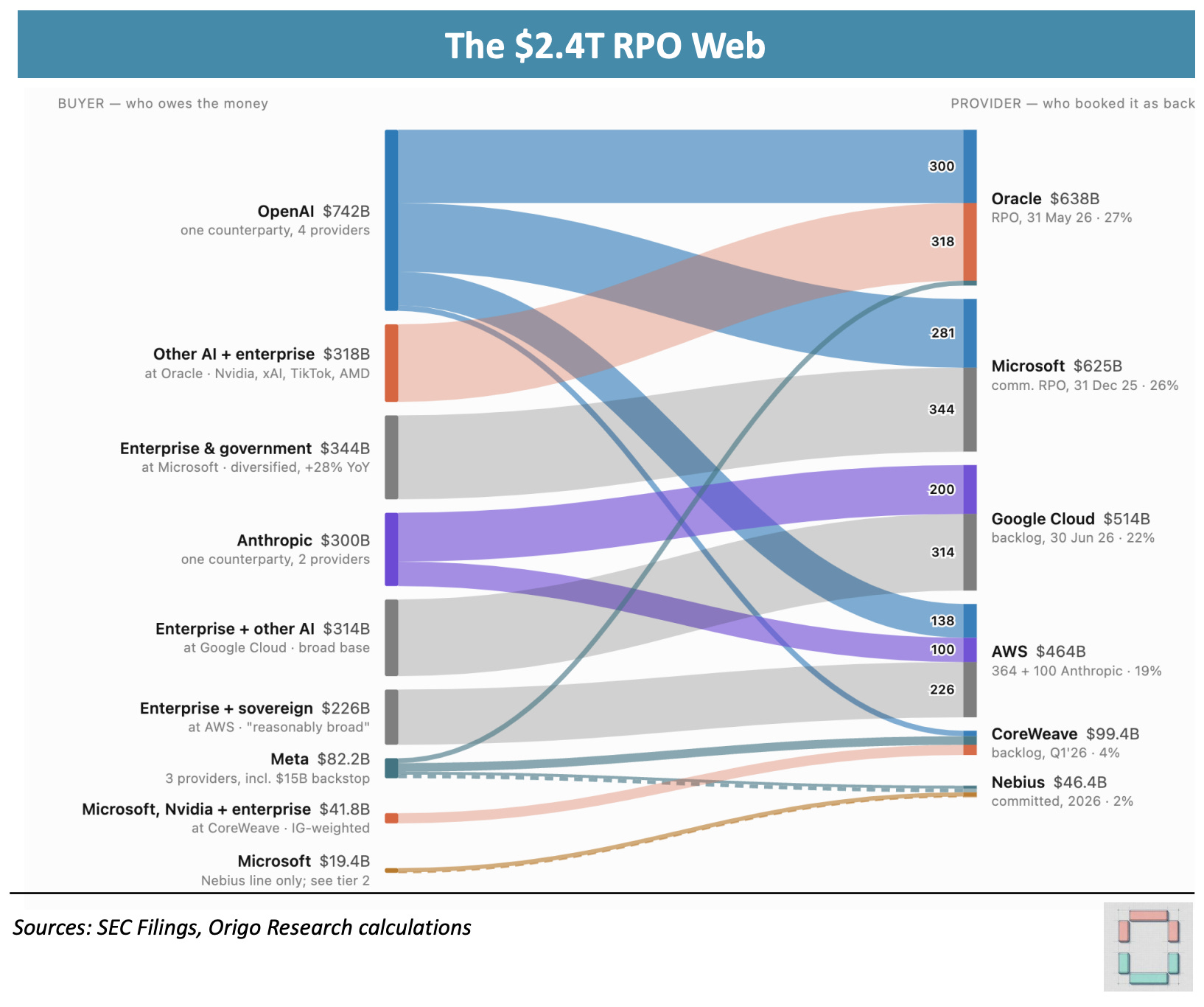
Of course, there is a supposed method to the madness. An insatiable demand for compute and $638B in RPO conversion – assuming OpenAI pulls through – is the prize at the end of the tunnel. The journey to the other side? A minefield which Larry Ellison is navigating with an increasingly limited toolkit.
A $40B Funding Gap
In order to deliver the ramp there is a significant capex outlay required to bring the capacity to full fit-out. Starting with FY27, which will be a real litmus test: $92B in gross capex, which cannot be fully funded organically.
The Company already knows that the IG bond market is almost capped out – adding an extra 1-1.5x of leverage here could tip ORCL firmly into junk territory.
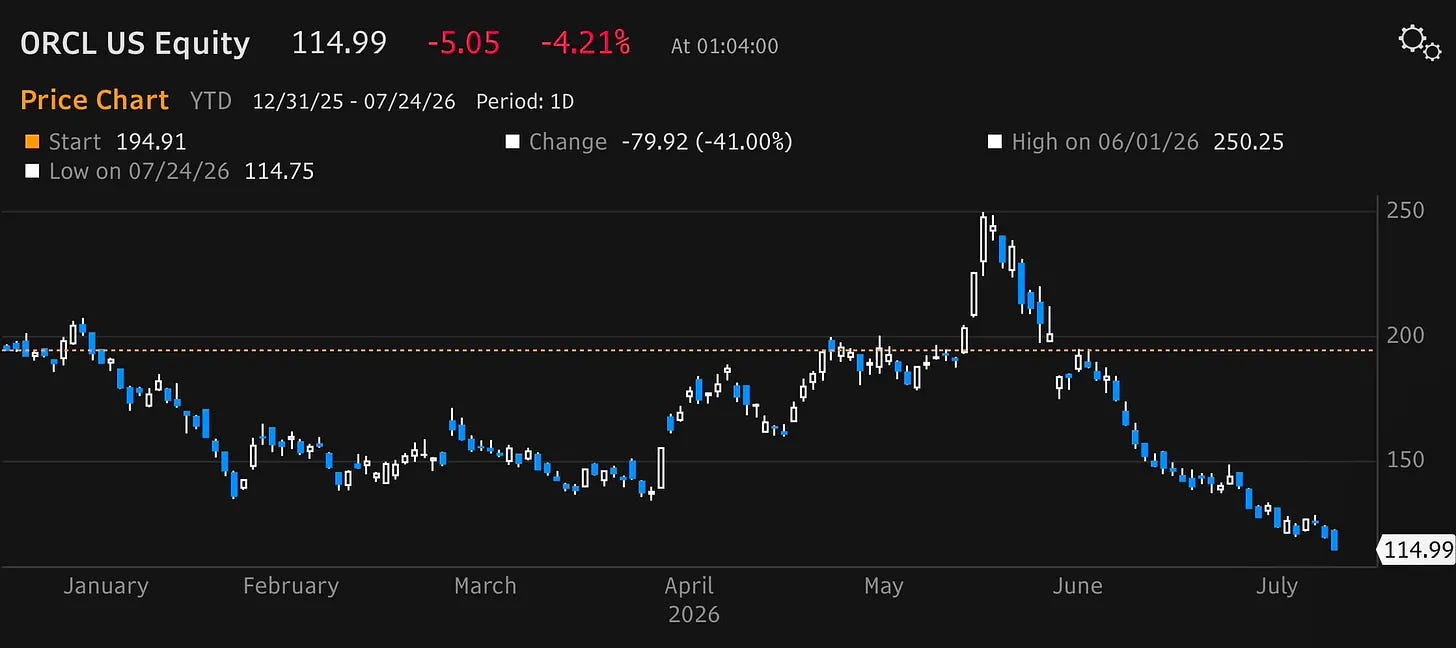
Which may mean issuing $40B of equity into a declining market cap?
A ~12% dilution at current levels for what would be somewhat of an unprecedented capital markets exercise at this scale!
There are some levers which ORCL can still pull if push comes to shove:
Our funding gap calculation leaves $25B in liquidity headroom (cash + RCF)
They can still cut $6B in dividends
The biggest lever is obviously resizing the capex spend – but at what cost?
See, ORCL is walking on a tightrope when it comes to sequencing the end-to-end delivery of its datacenter capacity. They can delay capex – but those lease commitments represent real fixed costs coming on-line regardless, and every delay ultimately eats into project IRRs and the economic viability of the entire strategy. If and when they decide to do this, it will be interesting to see how the market reacts.
The Open(AI) Question
Even if ORCL delivers its end of the bargain, the elephant in the room remains its concentrated RPO exposure to OpenAI: $300B.
This is of course magnified by the fact that ORCL is not OpenAI’s only provider – in fact OpenAI has over $440B of commitments in place with other counterparties.
The bull case – and what management is arguing – is that they are not worried about this concentration risk because excess compute will always find a home in the world in which we are headed.
Big picture, we would agree with this. Specifics are important though when we are dealing with limited margin of safety.
An aircraft lessor can reposition an aircraft away from a defaulted airline, but it might take 12 months of downtime, unforeseen maintenance costs and a lower lease-rate on the other side
So here is the (literal) trillion dollar question:
Is compute really fungible at scale?
We would put forward the following as food for thought:
Target universe: limited set capable of absorbing $300B in contracts
Correlation: if OpenAI is not money good, they will not be alone
Supply: if OpenAI is not money good, there will also be more supply
The risk is that ORCL becomes a known forced-seller of compute (affects price) and / or is obligated to pursue a more distributed strategy (which will take time, and time is money).
Fallen Angel or $1T Market Cap?
ORCL is at a critical inflection point in what looks like an increasingly binary set of potential outcomes.
Credit markets are spooked by the reality of the execution ramp-up risk: spreads have widened ~70bps since June and the CDS is at an ATH, exceeding 200bps.
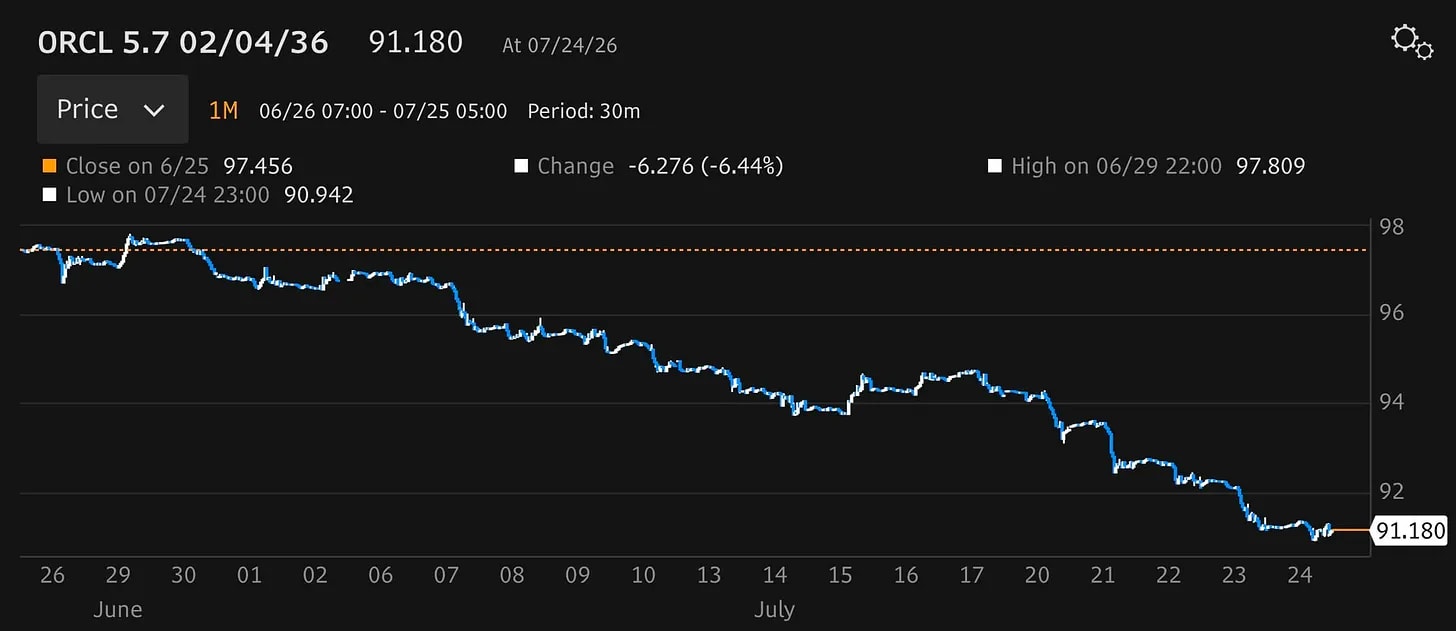
Oracle is one notch away from becoming the largest fallen angel in history (3x Ford in 2020), and would represent a whopping 8% of the index on entry.
Where ORCL does maintain some flexibility is the maturity schedule of its bond curve – a structured call option if you will.
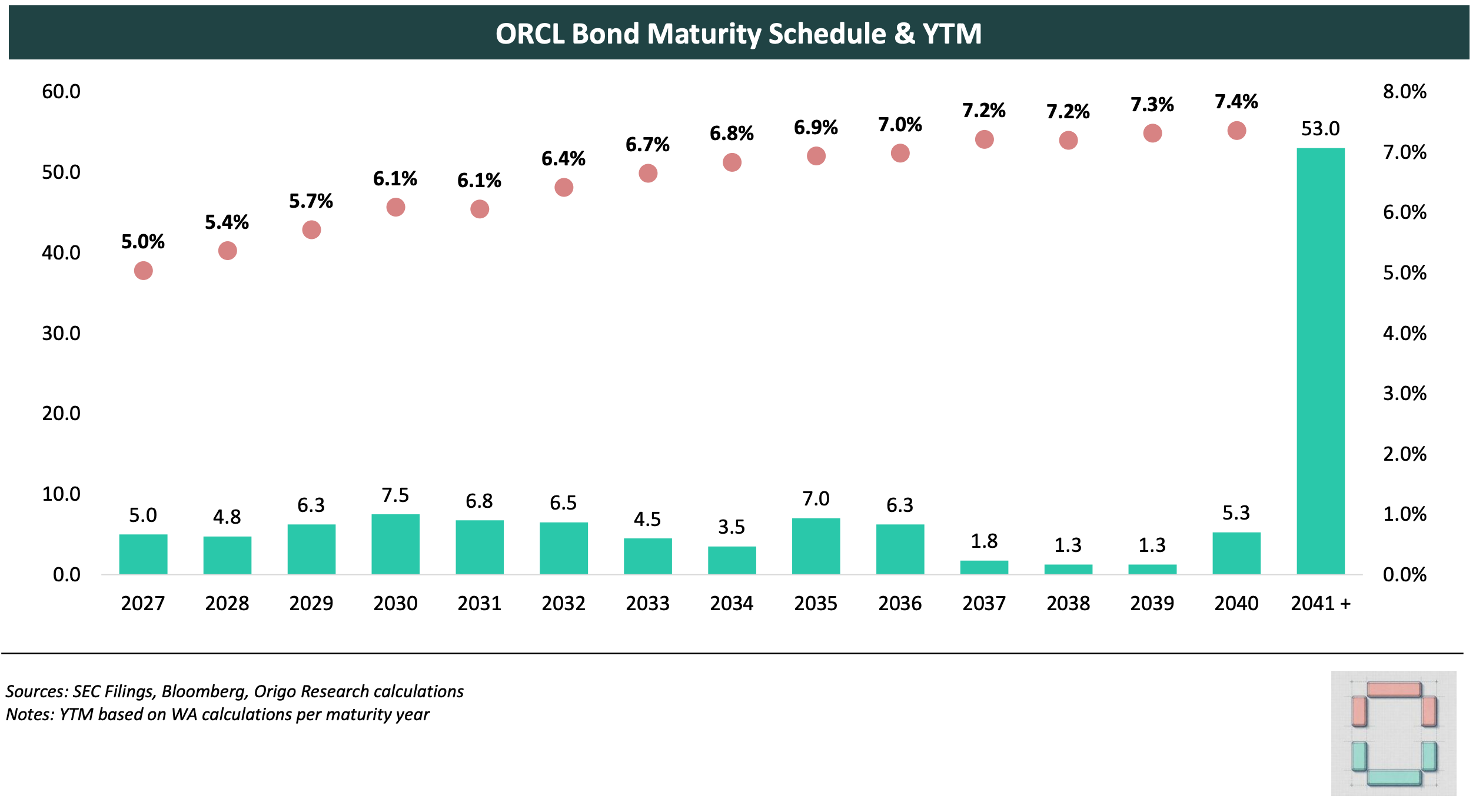
It will be fascinating to watch (from the sidelines for the time being) how this all unfolds over the next 12 months. We would not bet against Larry Ellison (besides the R/R is much less attractive here) but equally ORCL is leaving itself little room for manoeuvre, exposed to the forces of gravity in either direction.