Nuance matters when you are underwriting a set of contracts!
Welcome Back Everyone!
When we wrote Part 1backin late August, we postulated that we were in the early innings of a buyer’s market in AI infrastructure credit (and beyond).
Our growing conviction was not predicated on anything particularly heroic. Rather, a simple set of observations across both public and privates:
The sheer volume of issuance was forcing selectivity back into the markets
Market participants were transitioning from being underweight AI to managingconcentration risk
Path dependency and execution risk needed to be re-priced as evidenced by early signs of (inevitable) development delays (e.g. ORCL / New Mexico)
In other words, widening spreads and dispersion seemed inevitable across the spectrum of potential AI capex-related outcomes:
Clear ROI would only encourage more spend and a deluge of further supply
A pullback / negative credit event would trigger a broader sell-off
With this backdrop, we turned more cautious across the board and have mostly been waiting patiently on the sidelines.
Fast forward to today and the re-pricing is now well underway, exacerbated by this week’s elections generating the type of indiscriminate factor-driven sell-off that we love to take advantage of.
While we still view the above backdrop to be a multi-quarter story that will stretch well into 2027, it is now time to pay attention.
In this particular post, we will cover our latest thoughts on relative value in the space with a deep-dive focus on how we are thinking through the powered shell providers and the DC project finance complex.
Hopefully, you stayed liquid and were able to side-step most of the recent carnage. We look forward to playing more offence over the coming months.
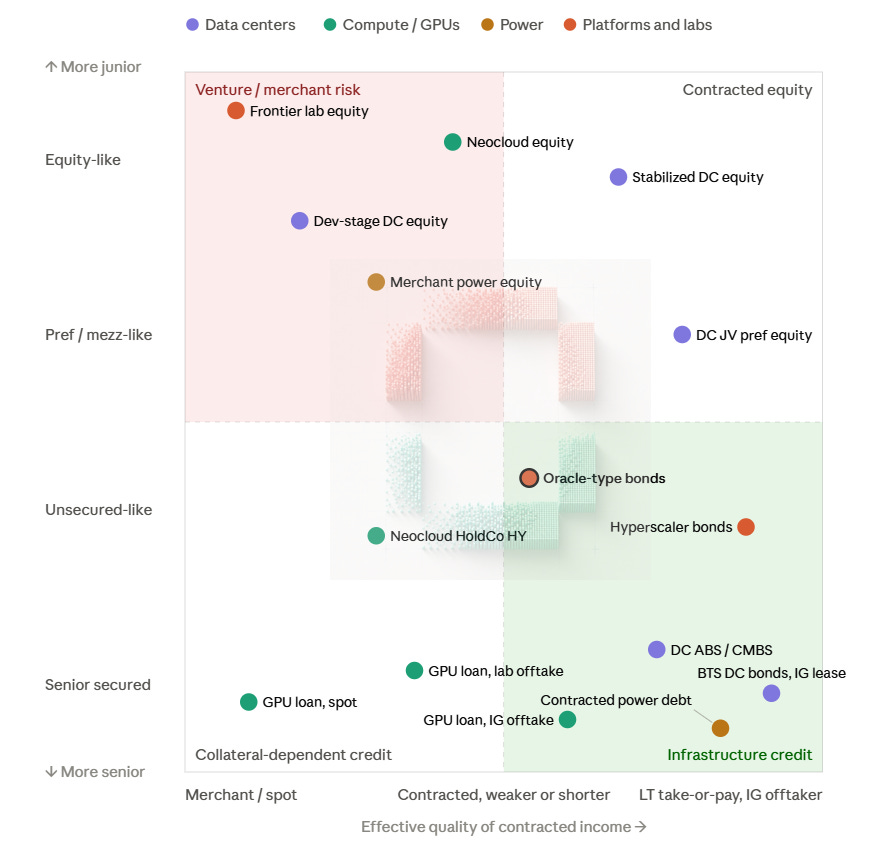
Relative Value Matrix Galore
The most important question confronting Investment Committees globally today is which part of the AI infrastructure stack offers the best risk-adjusted returns.
For those with broad or unconstrained mandates, this also involves taking a view on underlying fundamentals relative to positioning within the capital structure while accounting for duration, volatility and path dependency.
The aperture is vast, offering up fascinating debates.
Do you prefer:
GPU credit deals at 10-12%?
Neocloud unsecured risk at 15%?
Long-duration unsecured Hyperscaler risk at 8%?
Data center project finance with Hyperscaler off-take at 8%?
Data center project finance with sub-IG off-take at 12%?
Equity in high-quality contracted assets at >12% LFCF yield?
The list goes on, with each sub-category having its own set of RV nuances.
For the time being,our strategy has been to focus on the right-side of the matrix.
Why? Well we would rather play across the capital structure on a narrower and positively-skewed set of fundamental outcomes.
Simply put, we are looking to minimise the number of variables and play to our strengths (capital structure) rather than luring ourselves to believe we have a differentiated view on:
GPU prices
Hyperscaler capex
AI value accrual
Funding gaps / sources & cost of capital
Political and social climate, etc.
These combine for a wide range of outcomes, thus compounding the probability and scope of loss particularly for subordinated paper.
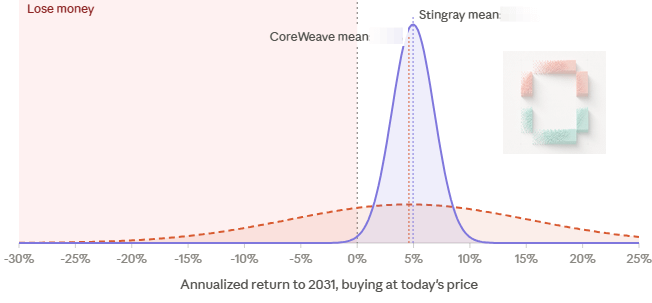
To give a rough illustration of what we mean, we might contrast the CoreWeave unsecured bonds at 15.9% YTM vs. the Stingray Project Finance bonds (close to RFS with Amazon 15Y off-take) at 7.3% YTM with nice optionality on 11.3% YTC.
We strongly prefer the R/R profile of Stingray bonds at this point in time. The equation is dynamic of course and we would reconsider if lower prices offered better convexity even in drastic restructuring scenarios.
Side note on tactical considerations & portfolio management
Since there is a decent chance we are still early to mid-cycle, we are further biased towards right-skewed assets with limited drawdown risk offering rotational “dry powder” down the line.
We like to clip high expected value returns while having a call option on a broader downturn.
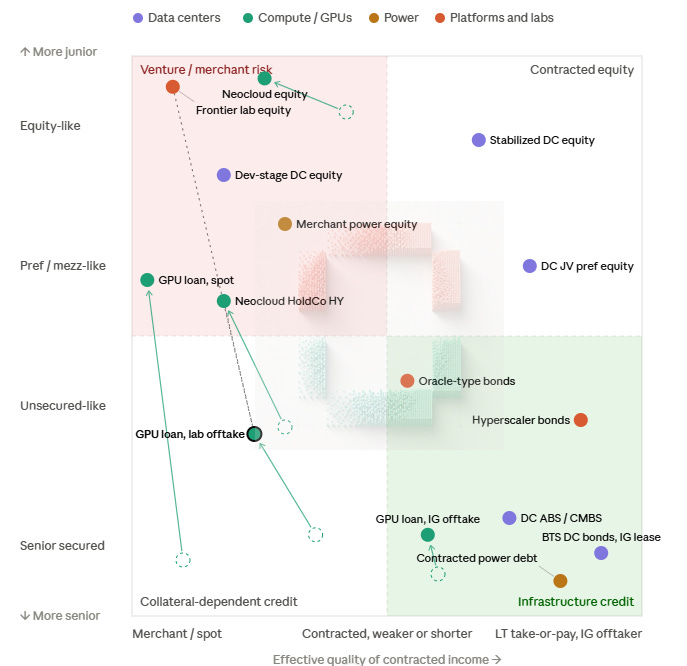
A good thought experiment is to think through how the matrix shifts in various scenarios. A drop in GPU prices might result in something like below, and you want to be extending that framework for the multitude of potential tail-risks out there.
Can you make money on CRWV in a beta-driven rally?
Absolutely, but that is a shorter-time frame game vs. the one we are playing here.
We would also arguethere are much better options for >20% returns today,including contracted equity plays post this week’s sell-off which offer both better downside and right-tail convexity. Let’s go deeper.